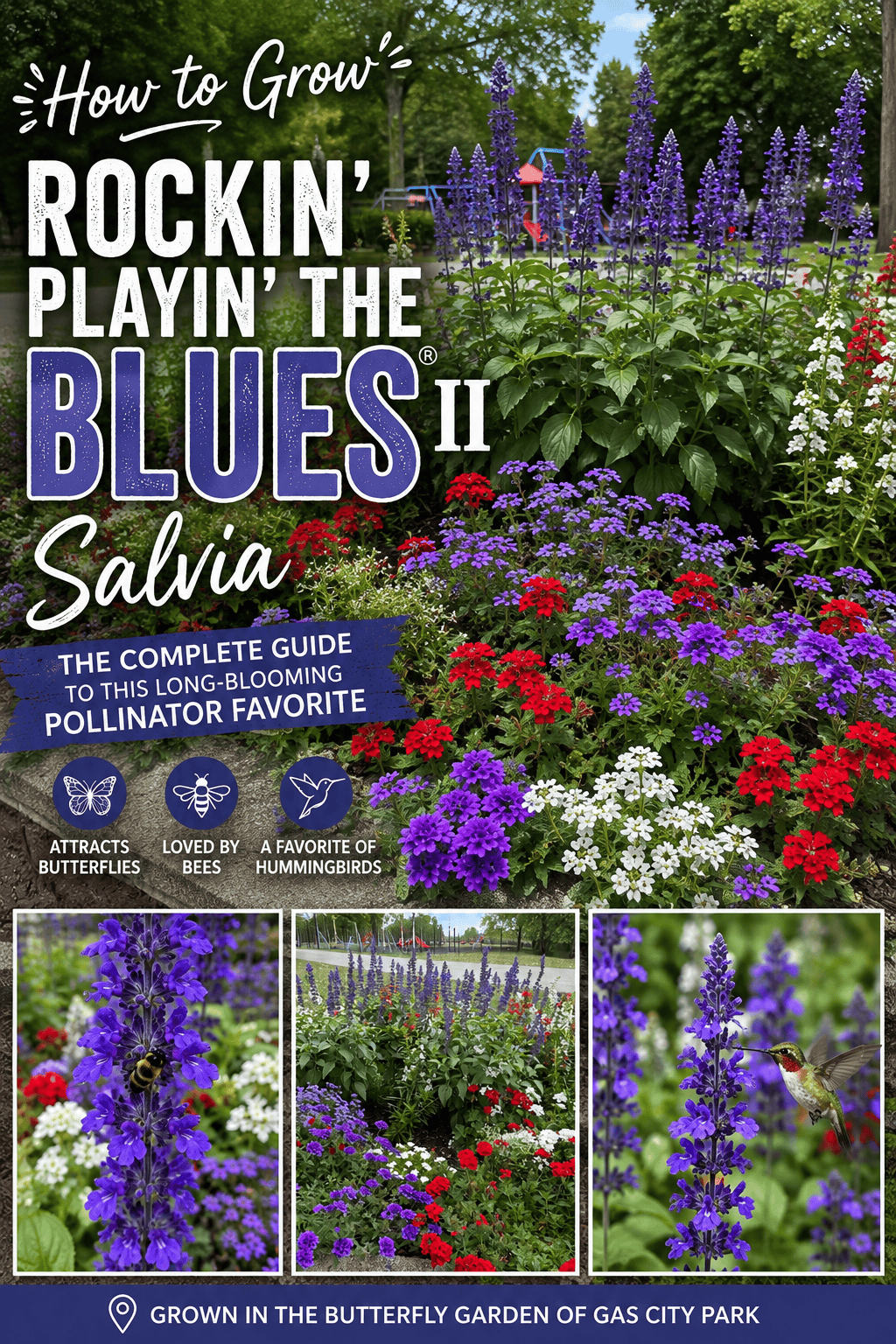
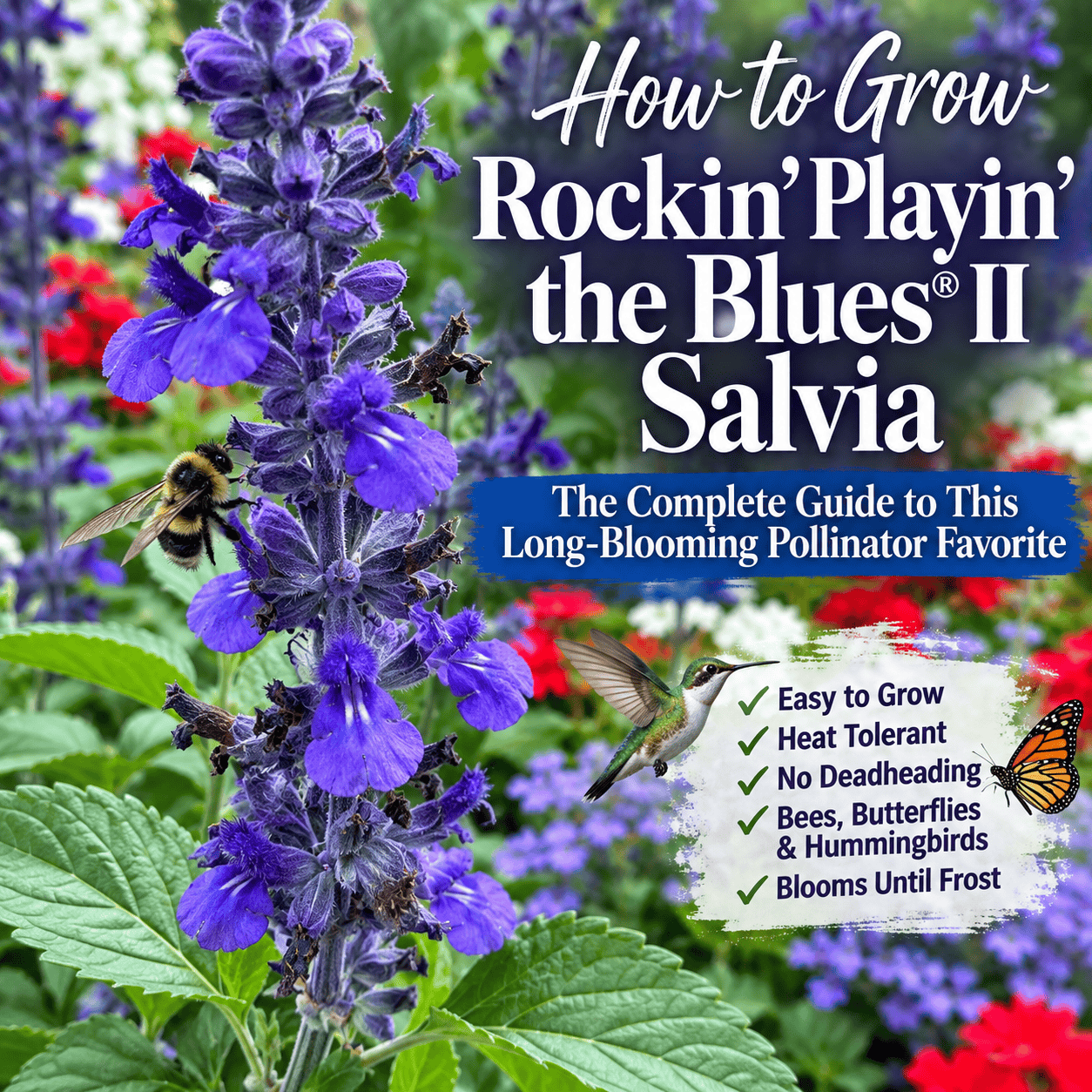
Rockin' Playin' the Blues® II Salvia has turned out to be one of those plants I find myself stopping to look at every time I visit the Butterfly Garden of Gas City - not just because of the flowers, but because there is almost always something visiting them.
When I chose this Proven Winners® salvia for the garden, I wanted more than another pretty flower.
I wanted a plant that could handle Indiana's unpredictable summer weather while providing a dependable source of nectar for pollinators.
It has exceeded my expectations.
The violet-blue flower spikes stay busy with bumblebees, honeybees, butterflies, and hummingbirds, and the plants continue blooming through summer heat with surprisingly little attention.
After watching it perform throughout the season, I understand why this salvia has become such a popular pollinator plant.
In this guide, I'll share my experience growing it, along with what you need to know to successfully grow it in your own garden.
Plant Profile: Rockin' Playin' the Blues® II Salvia
Before we dive into growing tips, here's a quick overview of what makes this plant so special.
| Plant Detail | Information | Plant Detail | Information |
|---|---|---|---|
| Botanical Name | Salvia longispicata × farinacea'Balsalmispim' | Common Name | Rockin' Playin' the Blues® II Salvia |
| Brand | Proven Winners® | Plant Type | Tender perennial, commonly grown as an annual |
| USDA Hardiness Zones | 7–10 | Bloom Time | Late spring through frost |
| Mature Height | 24–48 inches | Mature Width | 24–36 inches |
| Flower Color | Violet-blue with dark calyxes | Sun Exposure | Full sun to partial sun |
| Soil | Well-drained soil | Water Needs | Moderate once established |
| Deer Resistant | Yes | Rabbit Resistant | Generally yes |
| Attracts | Bees, butterflies and hummingbirds | Container Friendly | Yes |
| Deadheading | Minimal | Pollinator Friendly | Yes |
One of the biggest advantages of this variety is its incredibly long bloom season.
While many flowering annuals begin slowing down during the hottest part of summer, Rockin' Playin' the Blues® II continues producing flower spikes until frost with very little encouragement from the gardener.
Why Rockin' Playin' the Blues® II Salvia Surprised Me
I originally chose Rockin' Playin' the Blues® II Salvia for the Butterfly Garden of Gas City because I wanted blue flowers as part of our red, white, and blue planting for America's 250th birthday.
It was also included on The Garden Club of Indiana, Inc.'s list of recommended red, white, and blue plants for this year, and, since this is a butterfly garden, its value to pollinators made it an easy choice.
I planted it in late May, and I have been genuinely surprised by how well it has performed.
My previous experience with blue salvia has primarily been with perennial varieties, and I like this annual one better.
It grows quickly, fills out beautifully, stays upright, and I haven't deadheaded it once.
I also haven't seen any powdery mildew, which is especially impressive considering the weather we've had.
This has not been an easy Indiana summer.
We've had extreme heat, high humidity, too much rain, winds over 60 mph, and even an F1 tornado in the county.
Through all of it, this salvia has remained upright and continued looking good.
We do water the public garden regularly now, usually every day or every other day, but earlier in the season we were sometimes watering only once or twice a week as needed due to a lack of an easy way to get water to the plants.
I haven't fertilized the plants either.
What catches my attention every time I see them is the combination of height, clusters of blue flowers, and all the activity around them.
I've seen a variety of butterflies, many different kinds of bees, and even a hummingbird feeding from the flowers.
I expected to like this salvia when I planted it.
I didn't expect it to become a must-have in my own garden.
But it has become a plant I not only want in my personal garden, but one I can recommend for public gardens.
What Makes Rockin' Playin' the Blues® II Different?
At first glance, it might look similar to other annual salvias you've seen at your local garden center.
Look a little closer, however, and you'll notice several features that set it apart.
The flower spikes are exceptionally long and elegant, producing dozens of individual blossoms over an extended period.
Deep purple stems and calyxes provide additional color even before every flower has opened, giving the plant interest from the moment buds begin forming.
Perhaps its biggest advantage is something many gardeners never even notice.
Unlike many flowering plants, Rockin' Playin' the Blues® II is sterile.
Since it doesn't spend energy producing seeds, it can devote that energy to continuously producing new flowers instead.
That's one of the reasons it blooms so consistently from late spring until frost.
For gardeners, that means less deadheading, more flowers, and a landscape that looks colorful for months rather than weeks.
Why Pollinators Can't Resist This Salvia
One of my favorite things about maintaining the Butterfly Garden of Gas City is simply stopping to watch what happens when people aren't walking through the garden.
That's when the real show begins.
On warm summer mornings, honeybees are often among the first visitors, moving carefully from flower to flower collecting nectar.
Soon afterward, bumblebees arrive.
They're fascinating to watch because they practically disappear inside the blossoms, emerging covered in pollen before moving on to the next spike.
Throughout the afternoon, butterflies begin making regular visits.
I've watched swallowtails, painted ladies, and smaller butterflies drift among the flowers while bees continue working around them.
The different pollinators seem perfectly content sharing the same plants, each finding exactly what they need.
Then come the hummingbirds.
They're incredibly fast, so if you blink, you might miss them.
One moment the flower spikes are gently swaying in the breeze, and the next a hummingbird appears seemingly out of nowhere, hovering just long enough to sip nectar before darting away again.
It's a reminder that a truly pollinator-friendly garden isn't just beautiful - it's full of life.
And Rockin' Playin' the Blues® II Salvia has proven itself to be one of the busiest gathering places in the entire Butterfly Garden.
How to Grow Rockin' Playin' the Blues® II Salvia
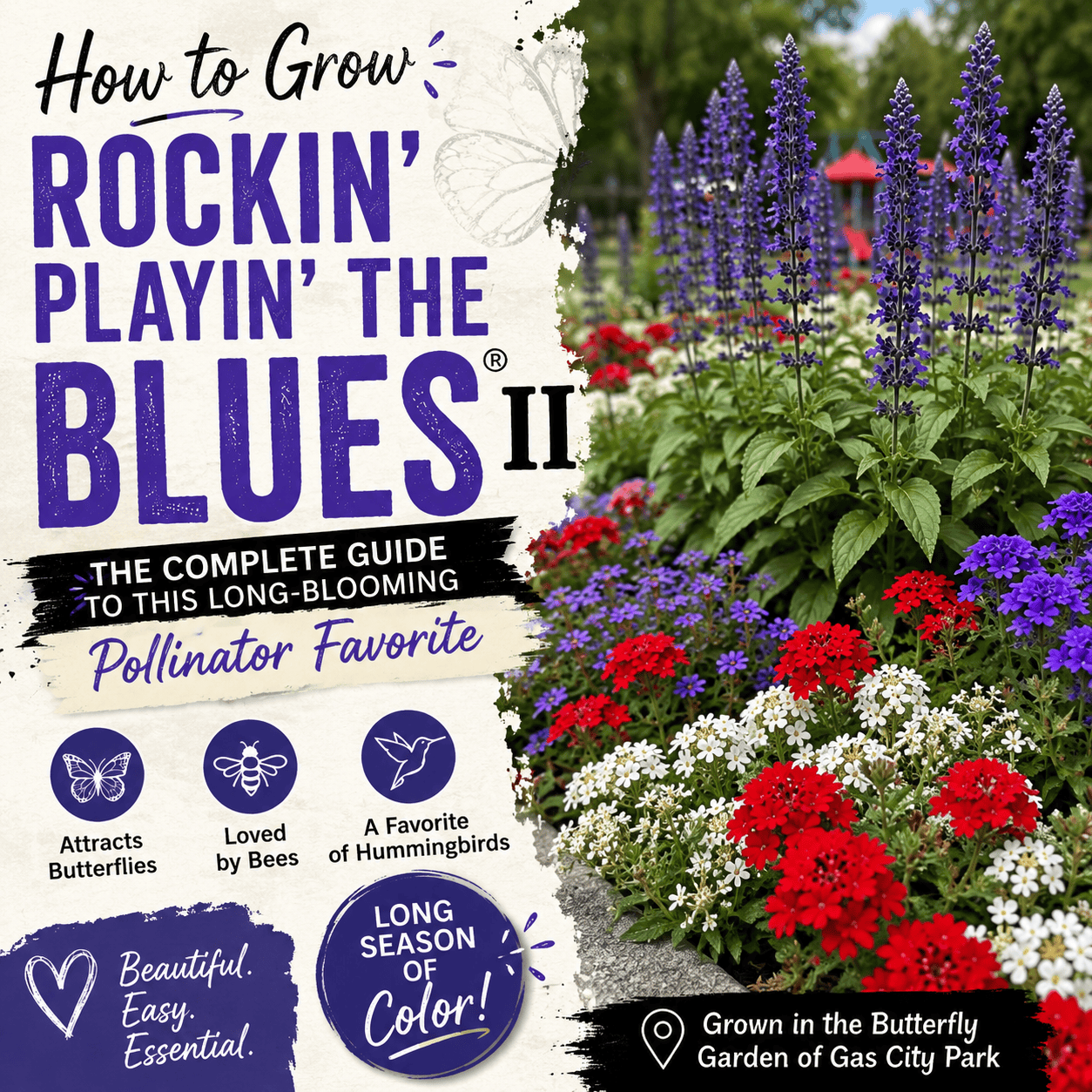
Rockin' Playin' the Blues® II Salvia has been surprisingly easy to grow in the Butterfly Garden of Gas City.
They went into the ground in late May and took off without any noticeable transplant shock, even though we still had some cold nights after planting.
Since then, the plants have grown quickly, filled out into attractive, bushy plants, and required almost no attention beyond watering.
I haven't fertilized, deadheaded, staked, pinched, or pruned them.
Of course, what works in one garden isn't a guarantee of what will happen in another.
Sunlight, soil, rainfall, and temperatures all affect plant performance.
Still, after seeing how forgiving this salvia has been through a particularly difficult Indiana summer, I would have no hesitation recommending it to a beginning gardener.
Choosing the Best Location
Rockin' Playin' the Blues® II Salvia performs best in plenty of sunshine, although some afternoon shade doesn't necessarily mean poor performance.
I have one growing in full sun in the Butterfly Garden of Gas City and another that receives some afternoon shade. Both have grown well and bloomed for us.
If you're choosing a location, look for a spot with plenty of direct sunlight and enough room for the plant to fill out.
These haven't grown as narrow, upright stalks.
They've developed into full, bushy plants with plenty of blue flower spikes.
The location also needs good drainage.
While the plants have tolerated an incredible amount of rain this year without showing signs of trouble, I still wouldn't intentionally plant salvia where water routinely stands around the roots.
Soil Requirements
Rockin' Playin' the Blues® II Salvia doesn't appear to need exceptionally rich soil to perform well.
The soil in the Butterfly Garden of Gas City was already decent garden soil, and the bed had been topped with compost from the zoo.
I didn't add amendments to the individual planting holes when I planted the salvias.
They've grown beautifully in those conditions.
If you're preparing a new bed, adding finished compost to your existing soil is a practical way to add organic matter and improve the growing area without creating an overly rich planting hole.
The most important consideration is drainage.
Salvia generally doesn't appreciate sitting in waterlogged soil, so if you have very heavy soil or an area where water collects after rain, improve the drainage or choose a different planting location.
What Soil pH Does Rockin' Playin' the Blues® II Salvia Need?
Rockin' Playin' the Blues® II Salvia isn't a plant I would obsess over when it comes to soil pH.
Good drainage, and adequate sunlight are much more important considerations for the average home gardener.
If you're unsure about your soil, a soil test is always worthwhile, particularly if other plants in the same area aren't performing as expected.
I wouldn't automatically start adding amendments simply because you're planting this salvia.
Our plants are growing in existing garden soil topped with compost, and I haven't made any special pH adjustments for them.
When to Plant Rockin' Playin' the Blues® II Salvia
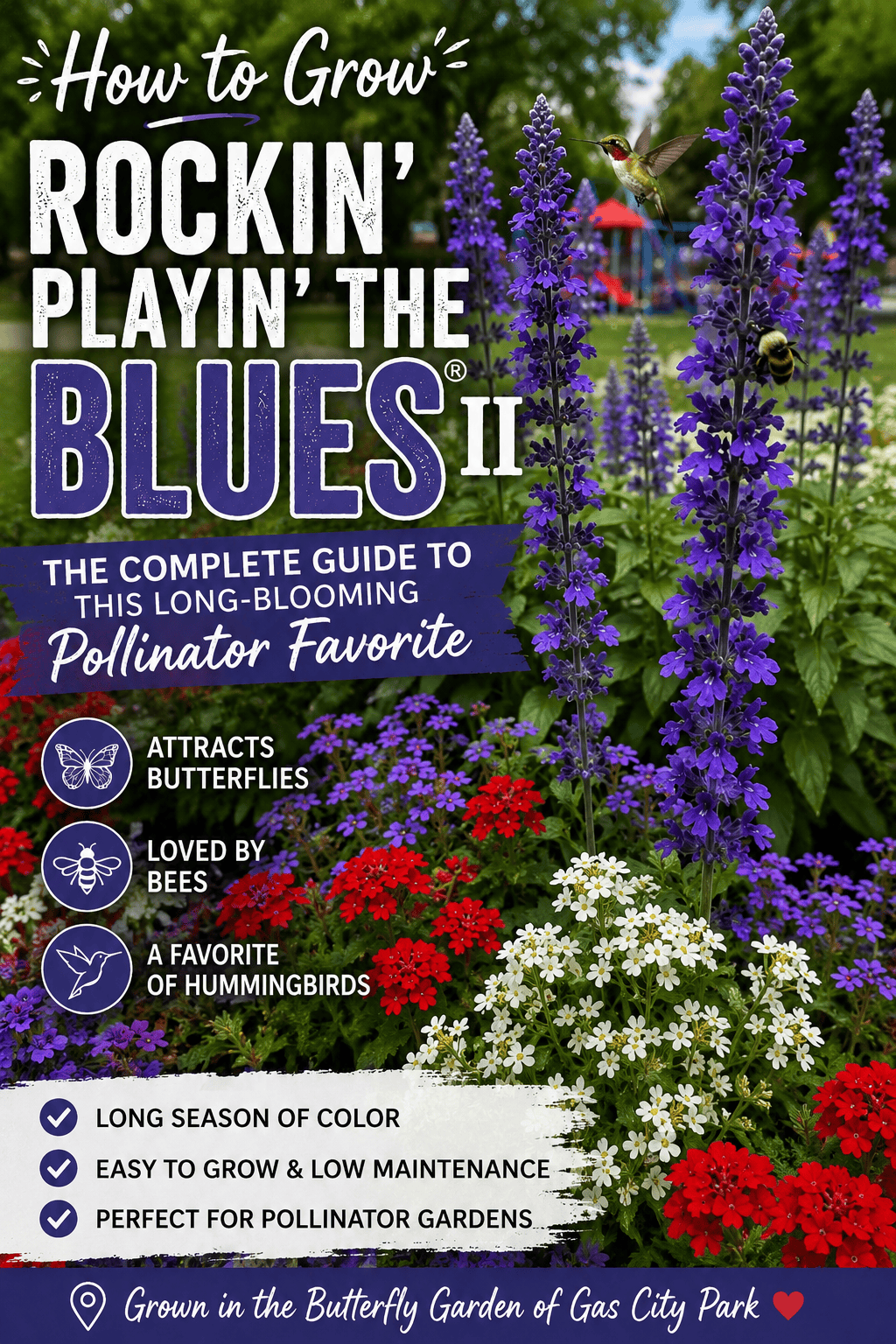
Plant Rockin' Playin' the Blues® II Salvia after the danger of a hard frost has passed and the weather has begun to warm.
I would not intentionally expose newly planted salvia to freezing temperatures.
Rockin' Playin' the Blues® II is a tender perennial that is grown as an annual in colder climates, including here in Indiana.
If you're planting greenhouse-grown plants, giving them a chance to gradually adjust to outdoor conditions before planting is still a good practice, especially if they've been grown in a protected environment.
How to Plant Rockin' Playin' the Blues® II Salvia
Plant Rockin' Playin' the Blues® II Salvia at the same depth it was growing in its container, then water it thoroughly to settle the soil around the roots.
The process is simple:
- Choose a sunny location with well-drained soil.
- Dig a hole slightly wider than the root ball.
- Remove the plant carefully from its container.
- Loosen tightly circling roots if the plant is root-bound.
- Position the top of the root ball level with the surrounding soil.
- Backfill with the soil you removed from the hole.
- Water thoroughly after planting.
- Add mulch around the plant, keeping it away from direct contact with the stems.
How Far Apart Should You Plant Rockin' Playin' the Blues® II Salvia?
Give Rockin' Playin' the Blues® II Salvia enough room to develop into the full, bushy plant it can become.
The recommended mature width is an important consideration when deciding on spacing.
I planted these a little closer together than recommended - not dramatically closer -and they've begun filling in nicely without causing problems.
If you're creating a public display, pollinator garden, or flower bed where you want a full look, it can be tempting to crowd young plants together.
Remember that these salvias grow quickly.
These looked considerably fuller within about a month of planting.
Adequate spacing also allows air to circulate between plants, which can help reduce conditions favorable to fungal diseases.
Interestingly, despite our humid weather, frequent rain, overhead watering, and relatively close spacing, I haven't seen powdery mildew or other disease problems on them.
How Often Should You Water Rockin' Playin' the Blues® II Salvia?
Water Rockin' Playin' the Blues® II Salvia regularly while it becomes established, but don't assume it needs daily watering once it's growing well.
Our watering schedule has actually changed during the season.
At one point, getting water to the Butterfly Garden wasn't easy, so the plants were sometimes watered only once or twice a week as needed.
I didn't notice them wilting or showing obvious signs of drought stress during that period.
Now that the garden has more regular watering, it is usually watered every day or every other day, mainly because of the extreme heat.
When I'm the one watering, I prefer to water deeply.
Because this is a public garden, however, I'm not always the person doing the watering.
The plants are also watered overhead rather than exclusively at soil level.
Despite that - and despite a summer with high humidity and far too much rain - I haven't seen fungal problems develop on these salvias.
For a home garden, I would base watering on your weather and soil rather than following a rigid schedule.
Check the soil and water when needed.
During a rainy week, that may mean you don't need to water at all.
During a prolonged hot, dry period, they'll naturally need more attention.
Does Rockin' Playin' the Blues® II Salvia Need Fertilizer?
Rockin' Playin' the Blues® II Salvia has grown extremely well for me without supplemental fertilizer.
The Butterfly Garden bed had been topped with compost from the zoo before planting, so the plants weren't growing in depleted soil.
However, I haven't applied granular fertilizer, liquid fertilizer, or any other supplemental plant food to these salvias since planting them.
They haven't seemed to need it.
They've grown quickly, filled out nicely, and continued producing flowers throughout the summer.
That doesn't mean salvia never needs fertilizer.
Plants growing in containers or very poor soil may benefit from additional nutrients.
But I wouldn't automatically assume that Rockin' Playin' the Blues® II needs frequent feeding.
Start with healthy soil containing organic matter, watch how the plant grows, and let the plant tell you whether additional fertilizer is actually necessary.
Mulching Rockin' Playin' the Blues® II Salvia
Mulching around Rockin' Playin' the Blues® II Salvia can help conserve soil moisture, suppress weeds, and keep the planting bed looking tidy.
We mulched the Butterfly Garden with a purchased shredded mulch.
Combined with the plants filling out as they've grown, weed pressure around the salvias has been minimal.
We also used Preen on the beds prior to planting to help prevent any weeds seeds that were in the compost from sprouting.
That's another thing I've appreciated about them.
Once they're established, they develop into substantial, bushy plants that don't leave a lot of bare space immediately around them.
Apply mulch around the root zone rather than piling it against the stems.
A layer of mulch can help the soil retain moisture during hot weather, but keeping the plant's crown clear helps prevent excess moisture from collecting directly around the stems and also helps keep pest damage down.
Growing Rockin' Playin' the Blues® II Salvia in Containers
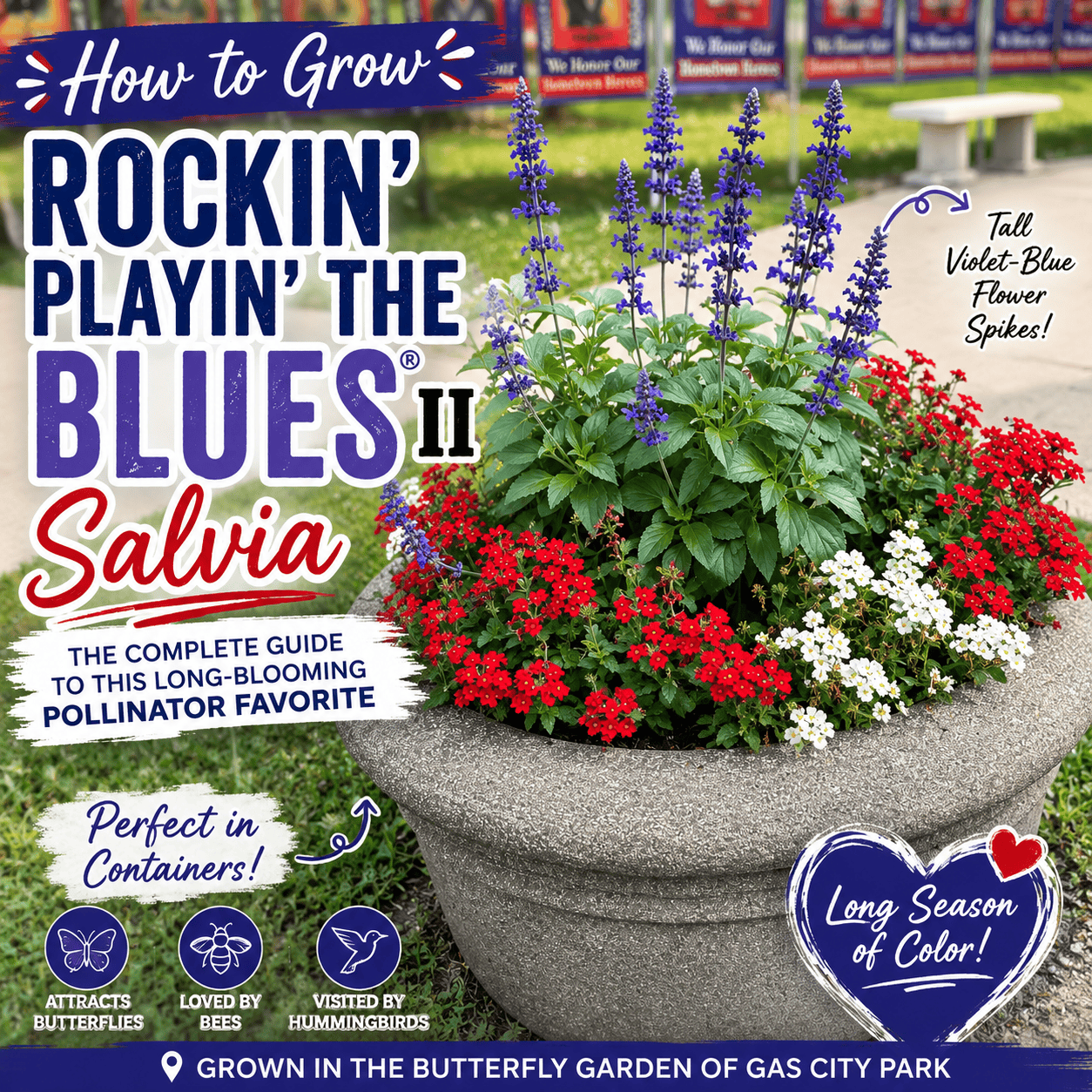
Rockin' Playin' the Blues® II Salvia can be grown in containers, but keep its mature size in mind when choosing a pot.
This is not a tiny bedding salvia.
It grows quickly and develops into a substantial, bushy plant, so I would give it a generously sized container rather than trying to squeeze it into a small pot.
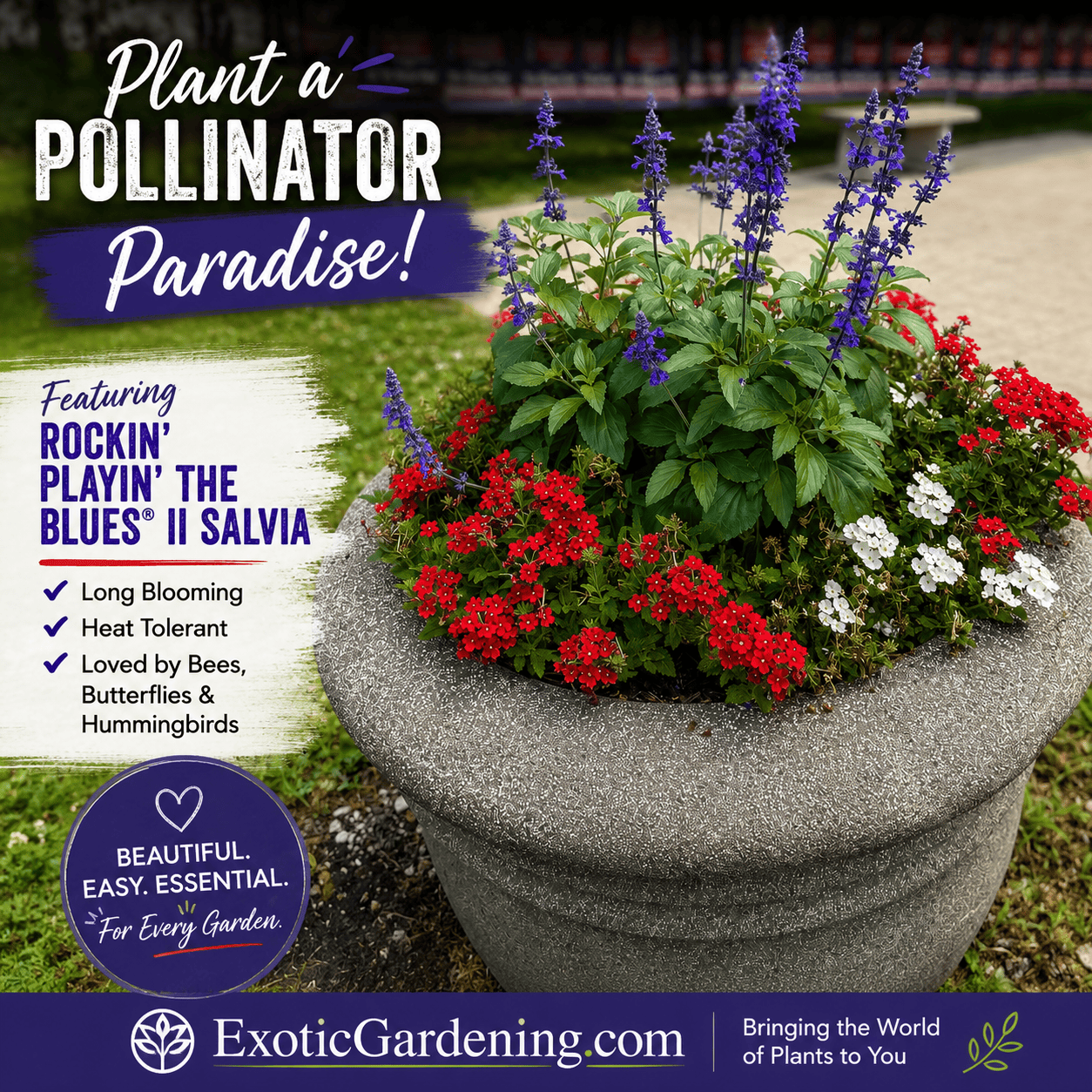
Its upright flower spikes make it a natural choice for adding height to a large mixed container, particularly when paired with lower-growing or trailing flowers.
Use a quality container mix and, most importantly, make sure the container has drainage holes.
Container-grown plants also tend to dry out faster than plants growing in the ground, so check the soil regularly during hot weather rather than assuming the watering schedule will be the same.
Does Rockin' Playin' the Blues® II Salvia Need Deadheading?
No.
Rockin' Playin' the Blues® II Salvia does not require deadheading to continue blooming, and I haven't deadheaded mine at all.
That has been one of my favorite things about growing it.
As older flowers fade, they seem to blend into the plant while new flowers continue opening.
I haven't felt the need to remove the spent flower spikes simply to keep the plants looking good.
Rockin' Playin' the Blues® II is sterile, which means it doesn't produce viable seed.
Instead of putting energy into seed production, it can continue producing flowers throughout the growing season.
You can certainly remove an old or damaged flower spike if you don't like the way it looks, but based on my experience in the Butterfly Garden of Gas City, deadheading isn't necessary.
For a plant in a public garden - where I want something to look good without creating another maintenance chore - that's a big advantage.
Why Pollinators Love Rockin' Playin' the Blues® II Salvia
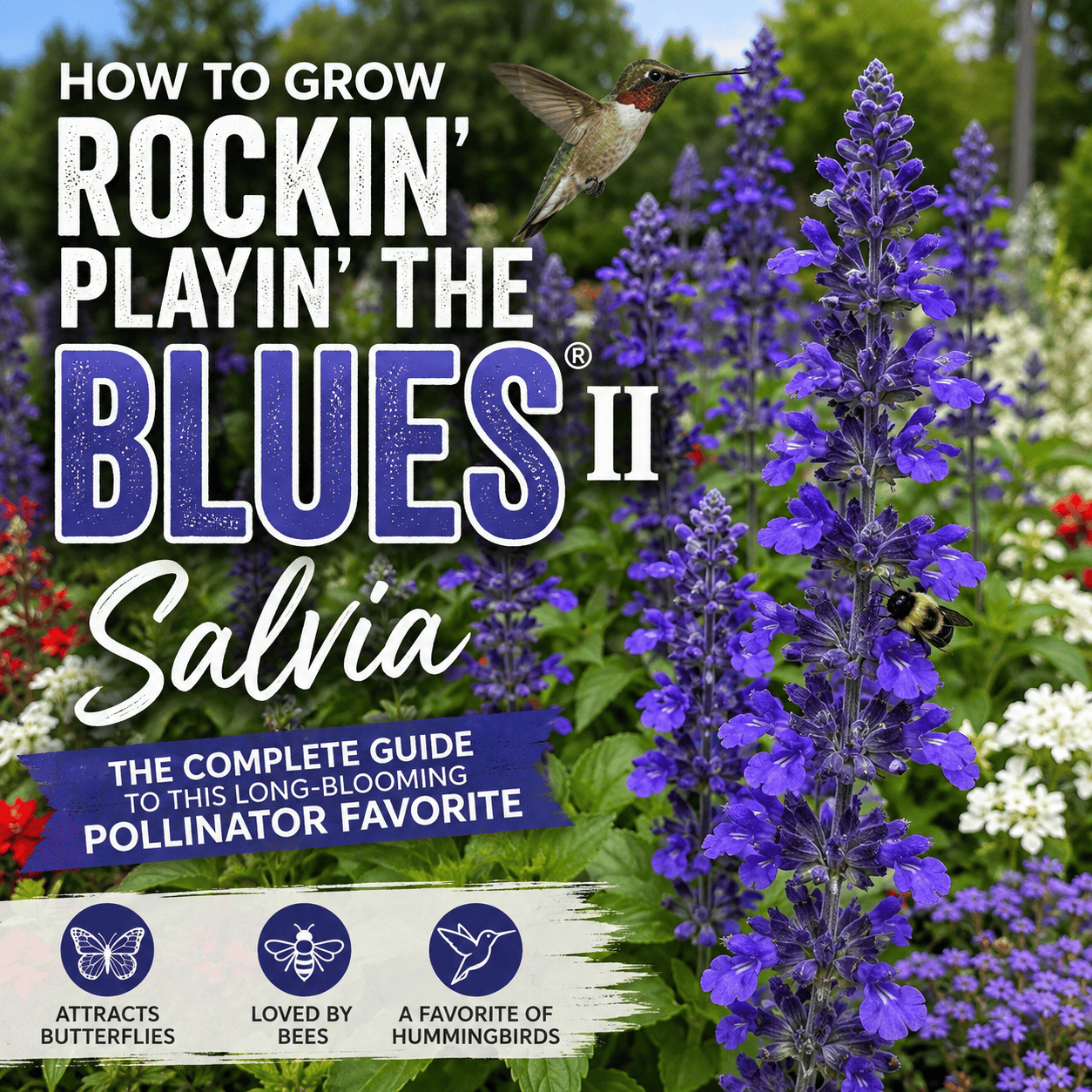
Rockin' Playin' the Blues® II Salvia attracts bees, butterflies, and hummingbirds with its nectar-rich, tubular flowers and long bloom season.
In a pollinator garden, that combination is especially valuable because a plant that continues flowering for months can provide food long after shorter-blooming plants have finished.
I've certainly seen that happening in the Butterfly Garden of Gas City.
There are almost always bees around these plants, and I've seen a variety of butterflies visiting the flowers as well.
I've even watched a hummingbird stop to feed.
When I stand back and look at the plants, the combination of those tall clusters of blue flowers and all the pollinator activity around them is one of the things that catches my attention most.
That's also why I don't judge a pollinator plant solely by how many flowers it produces.
A beautiful flower is wonderful, but in a butterfly garden I want that flower to serve a purpose.
I want to see insects and birds actually using it.
Rockin' Playin' the Blues® II Salvia does exactly that.
More Than Just a Butterfly Plant
Although we're growing Rockin' Playin' the Blues® II in a butterfly garden, butterflies are only part of the story.
Bees have been some of the most frequent visitors I've observed.
That's important because a good pollinator garden shouldn't be designed for only one species.
Different pollinators use different flowers, and providing a variety of flower shapes and bloom times makes the entire garden more useful.
That's one reason I like to think about a pollinator garden as a complete habitat rather than a collection of pretty flowers.
Milkweed provides host plants for monarch caterpillars.
Nectar plants feed adult butterflies and other pollinators.
Different flower shapes accommodate different visitors.
Having something blooming throughout the growing season helps prevent gaps when nectar becomes harder to find.
No single plant can provide everything a pollinator garden needs.
Rockin' Playin' the Blues® II Salvia, however, can be an excellent part of that larger planting.
Companion Plants for Rockin' Playin' the Blues® II Salvia
When I planted Rockin' Playin' the Blues® II Salvia in the Butterfly Garden of Gas City, I wasn't choosing companion plants based on a typical "plants that grow well with salvia" list.
I had a specific design in mind.
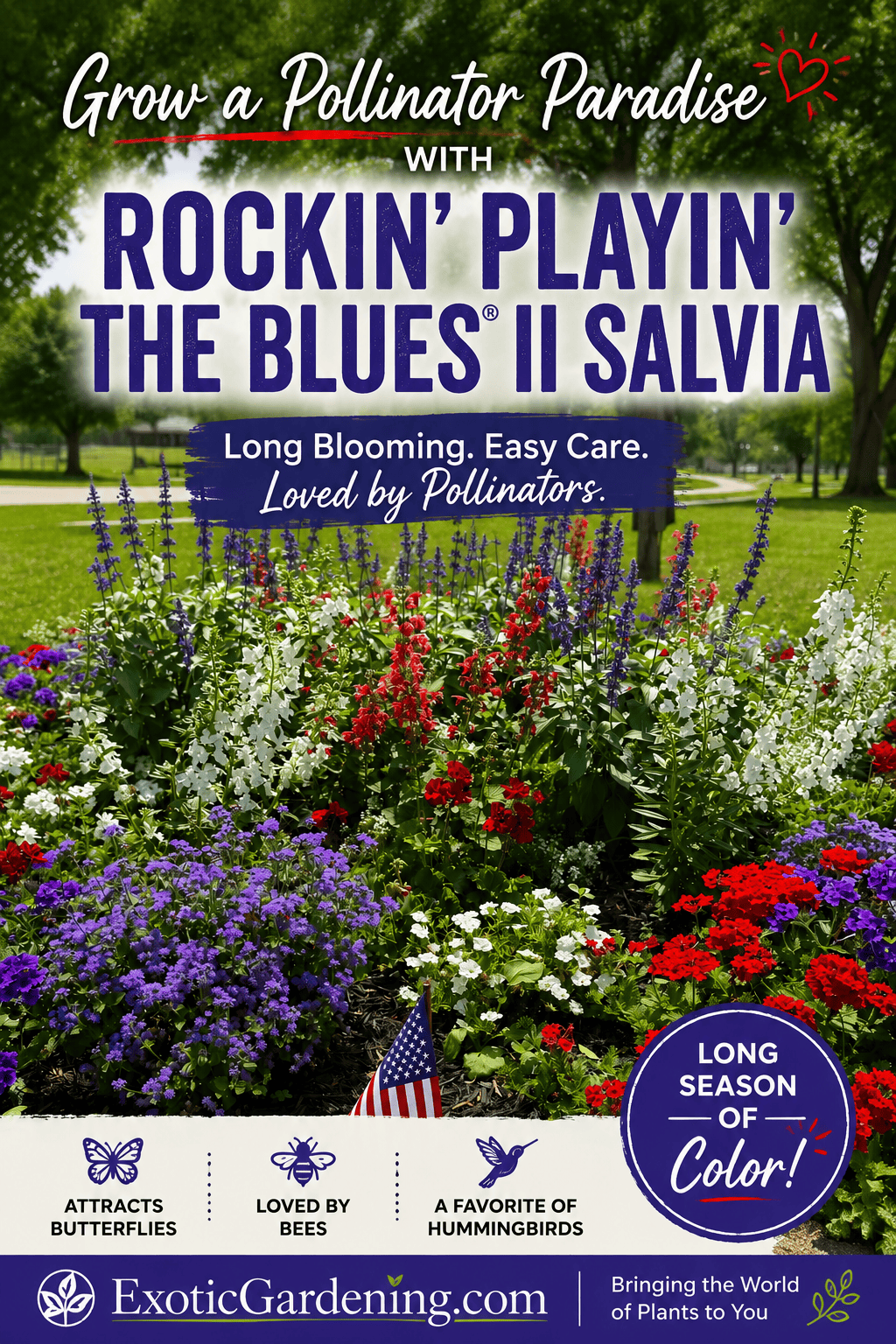
For America's 250th birthday, I wanted this bed filled with red, white, and blue flowers, while still keeping the purpose of the Butterfly Garden in mind.
That meant choosing plants that worked together visually, could handle the conditions in a public garden, and, whenever possible, offered something to pollinators.
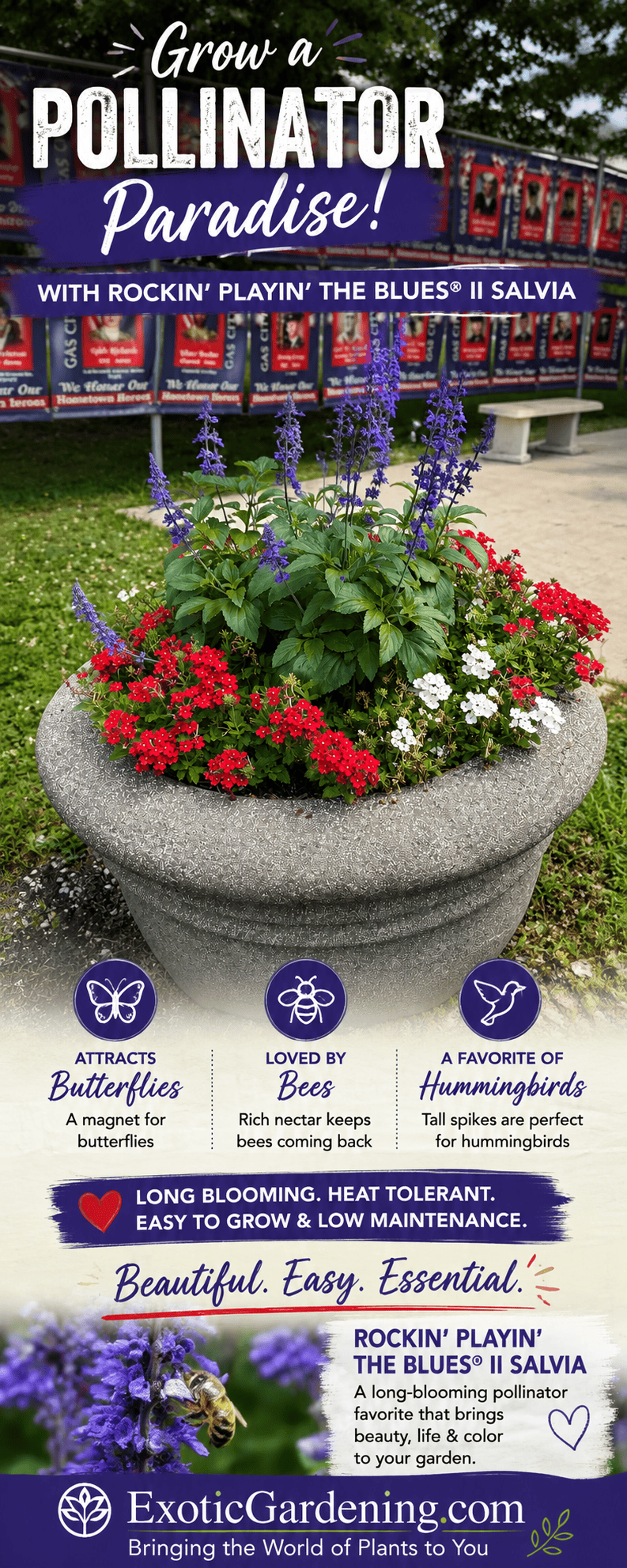
The height of Rockin' Playin' the Blues® II Salvia made it especially useful toward the center of the planting, while lower-growing verbena, calibrachoa, sweet alyssum, and other flowers helped fill the front and edges.
Repeating red, white, and shades of blue throughout the bed tied everything together instead of creating three separate blocks of color.
Some of the plants I've used with Rockin' Playin' the Blues® II include:
Superbena® Cobalt™ Verbena
Superbena® Cobalt™ Verbena adds another blue-purple tone at a lower height, making it a natural companion for the taller salvia.
The difference in flower shape also adds more variety to a pollinator planting.
Diamond Frost® Euphorbia
Diamond Frost® Euphorbia brings a light, airy texture to the garden.
Its tiny white flowers provide a completely different look from the larger blue salvia spikes and help break up heavier masses of color.
Artist® Blue Ageratum
Artist® Blue Ageratum was another blue flower I chose for our red, white, and blue theme.
It provides a lower-growing mass of blue flowers that contrasts with the taller salvia.
Interestingly, the Artist® Blue Ageratum has struggled more during our difficult Indiana summer, while Rockin' Playin' the Blues® II Salvia has continued looking good.
They're very different plants, so I wouldn't consider that a direct comparison, but it has made the salvia's performance stand out even more to me.
Superbells® Double Ruby Calibrachoa
Superbells® Double Ruby Calibrachoa adds the red portion of the color palette.
Its lower, spreading growth creates a very different layer from the tall salvia spikes.
Unplugged® Red Salvia
Unplugged® Red Salvia brings the red into the red, white, and blue color scheme while repeating the upright flower shape of Rockin' Playin' the Blues® II Salvia.
I especially like the way the two salvias work together because they create some consistency in height and form without looking like the same plant in different colors.
The bright red flowers also add another nectar-rich choice for pollinators, making it a natural companion for a butterfly garden.
Snow Princess® Sweet Alyssum
Snow Princess® Sweet Alyssum creates a completely different effect at the base of the taller salvia and the front of the beds.
Instead of competing with those upright violet-blue flower spikes, it forms masses of tiny white flowers that soften the edges of the planting and help fill spaces between larger plants.
The white flowers were also an easy way to carry the patriotic color scheme through the bed while adding another flower that attracts beneficial insects.
Solera Dark Red Geranium
Solera Dark Red Geranium adds bold red flower clusters and a completely different leaf shape to the planting.
I like having those rounded flower heads mixed among the more vertical plants because they break up all those spikes and keep the bed from becoming visually repetitive.
The dark red also provides a deeper shade of red that works especially well against the violet-blue Rockin' Playin' the Blues® II Salvia.
The only downside of this plant is it does need regular deadheading to keep it looking nice.
Superbells® Double White Calibrachoa
Superbells® Double White Calibrachoa brings white flowers lower into the planting and helps create layers of color from the front of the bed to the taller plants in the back.
The double flowers have a fuller appearance than single calibrachoa blooms, which gives them plenty of visual impact despite their smaller size.
Their lower, spreading growth also makes a nice contrast with the height and upright habit of Rockin' Playin' the Blues® II Salvia.
Superbena® Red Verbena
Superbena® Red Verbena adds another strong red to the planting without competing with the salvia for height.
Its clusters of flowers spread through the lower part of the bed, helping connect the taller plants with those growing along the edge.
I like this combination because the red verbena draws your eye across the planting instead of concentrating all of the red in one area.
Superbena® Whiteout™ Verbena
Superbena® Whiteout™ Verbena helps repeat the white portion of the color scheme throughout the garden rather than leaving white flowers in just one section.
Its spreading habit works especially well in front of taller plants such as Rockin' Playin' the Blues® II Salvia.
The clusters of white flowers also brighten the planting and provide a clean contrast against the darker violet-blue salvia spikes.
Angelface® Super White Summer Snapdragon
Angelface® Super White Summer Snapdragon gives the planting another tall, upright element, but its white flowers create a completely different look beside Rockin' Playin' the Blues® II Salvia.
I especially like the blue and white together.
Both plants provide vertical interest, so they help give the center of the bed some height while the verbena, calibrachoa, alyssum, and other lower-growing plants fill in around them.

Designing a Red, White and Blue Pollinator Garden
The blue color of Rockin' Playin' the Blues® II Salvia was actually one of the main reasons I chose it for the Butterfly Garden of Gas City.
For 2026, I wanted to create a red, white, and blue planting in recognition of America's 250th birthday. Rockin' Playin' the Blues® II was also among the red, white, and blue plants recommended by The Garden Club of Indiana, Inc. for the year, so it fit beautifully with what I was trying to accomplish.
But I didn't want to create a patriotic color scheme at the expense of the garden's real purpose.
It's still a butterfly garden.
That meant the plants needed to contribute something beyond color whenever possible.
I wanted flowers that could help provide nectar for butterflies, bees, hummingbirds, and other pollinators while giving us the red, white, and blue display I envisioned.
Rockin' Playin' the Blues® II has given us exactly the kind of blue I wanted.
The tall clusters of violet-blue flowers are noticeable from a distance, but they also work well with the other colors around them.
That's one of the things I enjoy about designing gardens around a theme.
You don't have to choose between creating something beautiful for people and something useful for wildlife.
With thoughtful plant choices, you can do both.
Rockin' Playin' the Blues® II vs. Other Popular Salvias
Choosing a salvia isn't necessarily about finding the "best" one.
It's about choosing the type that provides what you want in your particular garden.
Some salvias are hardy perennials that return year after year.
Others are grown primarily for season-long color.
Mature size, growth habit, flower color, bloom time, and winter hardiness can also vary considerably.
My own experience with blue salvia before growing Rockin' Playin' the Blues® II was primarily with perennial varieties. After growing this one, I prefer its full growth habit and long-lasting display for the type of planting I wanted in the Butterfly Garden of Gas City.
Here's how Rockin' Playin' the Blues® II differs from several other blue salvias gardeners may encounter.
Rockin' Playin' the Blues® II vs. Black & Blue Salvia
Rockin' Playin' the Blues® II and Black & Blue Salvia both provide striking blue flowers and are grown in pollinator and hummingbird gardens, but they aren't interchangeable plants.
Black & Blue Salvia is known for its dramatic cobalt-blue flowers and very dark calyxes and can develop into a large plant under favorable conditions.
Rockin' Playin' the Blues® II offers the bushy, upright habit I've come to appreciate in the Butterfly Garden along with a long season of violet-blue flowers.
It is also sterile, so viable seed production isn't part of its growth cycle.
When choosing between them, consider available space, desired flower color, mature plant size, and whether you're looking for a plant that fits easily among other annuals or a larger salvia with a more dramatic presence.
Rockin' Playin' the Blues® II vs. Mystic Spires Blue Salvia
Mystic Spires Blue and Rockin' Playin' the Blues® II are both blue-flowering salvias grown for summer color and pollinator appeal.
One important characteristic of Rockin' Playin' the Blues® II is its sterility.
Because it doesn't produce viable seed, it can continue directing energy toward flowering rather than seed production.
I haven't grown Mystic Spires Blue alongside Rockin' Playin' the Blues® II in the Butterfly Garden, so I can't give you a side-by-side performance test from my own garden.
What I can tell you is that Rockin' Playin' the Blues® II has given me exactly what I wanted: fast growth, a full plant, an upright habit, plenty of flowers, no deadheading, and excellent performance through an extremely challenging Indiana summer.
Rockin' Playin' the Blues® II vs. Victoria Blue Salvia
Victoria Blue Salvia is another blue salvia gardeners may encounter when shopping for bedding plants.
When comparing it with Rockin' Playin' the Blues® II, pay attention to mature height and width, growth habit, bloom season, and whether the plant fits the particular role you need filled in your landscape.
Rockin' Playin' the Blues® II has developed into a substantial, bushy plant in the Butterfly Garden rather than behaving like a small bedding plant.
That makes it especially useful when you want noticeable height and masses of blue flowers.
If you're shopping for either plant, don't judge them only by their size at the garden center.
Check the expected mature dimensions before deciding where to put them.
Rockin' Playin' the Blues® II vs. May Night Salvia
May Night Salvia and Rockin' Playin' the Blues® II serve very different purposes in a garden.
May Night (Salvia nemorosa) is grown as a hardy perennial in suitable climates, while Rockin' Playin' the Blues® II is a tender perennial that I grow as an annual here in Indiana.
That distinction may make the decision for you.
If your priority is a perennial salvia that returns year after year, a hardy perennial such as May Night makes sense.
If you're looking for vigorous seasonal growth and flowers that continue through summer, Rockin' Playin' the Blues® II offers something different.
My previous experience with blue salvias has primarily been with perennial types, and that's one reason this plant surprised me so much.
For season-long performance, I prefer Rockin' Playin' the Blues® II.
That doesn't mean I would stop growing perennial salvias.
They simply fill different roles in the garden.
Annual vs. Perennial Salvia: Which Should You Choose?
Choose an annual or tender perennial salvia when your priority is season-long color, fast growth, and the freedom to change your planting from year to year.
Choose a hardy perennial salvia when you want a plant that returns each spring and becomes part of the permanent structure of your landscape.
There is no reason you can't grow both.
Perennial salvias can become part of the framework of a flower bed or pollinator garden, while annual and tender perennial salvias can fill spaces with additional color and nectar during the growing season.
For me, growing Rockin' Playin' the Blues® II has changed the way I look at annual salvia.
I didn't expect to prefer it to the perennial blue salvias I've grown, but I do.
Is Rockin' Playin' the Blues® II Salvia Worth the Cost?
For me, Rockin' Playin' the Blues® II Salvia has been worth growing because of how much it has delivered without requiring much work from me.
I haven't fertilized it, deadheaded it, staked it, pinched it, or pruned it.
It has filled out quickly, continued flowering, attracted pollinators, and remained upright through some terrible Indiana weather.
That matters when I'm choosing plants for a public garden.
A plant that requires constant grooming may be beautiful, but every maintenance task adds up.
Something that continues looking good with basic care is much easier to recommend for a landscape where people want dependable color without constantly fussing over their plants.
Would I buy Rockin' Playin' the Blues® II for my own garden after growing it at the Butterfly Garden?
Yes.
It has become a must-have for me.
Who Should Grow Rockin' Playin' the Blues® II Salvia?
Rockin' Playin' the Blues® II Salvia is especially well suited to gardeners who want a long-blooming, pollinator-friendly plant without adding a lot of maintenance to their summer garden.
Based on my experience growing it, I would recommend it for:
- Beginning gardeners who want something forgiving and easy to maintain.
- Pollinator gardens designed to attract bees, butterflies, and hummingbirds.
- Public and community gardens where plants need to look good without constant attention.
- Sunny flower beds that need height and a strong mass of color.
- Gardeners who don't want to spend the summer deadheading flowers.
- Mixed annual beds where a taller, bushier plant can provide structure.
- Large containers that need an upright focal plant.
- Gardeners looking for blue or violet-blue flowers.
- Landscapes that experience hot, humid summers.
- Gardeners who like salvia but want a different experience from traditional perennial blue salvias.
I would especially consider it for public gardens.
That's not something I say simply because the plant is attractive.
I've seen firsthand how little maintenance ours have required.
In a public planting, where there is always something that needs watering, weeding, trimming, or fixing, a plant that largely takes care of itself is incredibly valuable.
And if you're a beginner wondering whether you can grow it?
I wouldn't hesitate to recommend trying it.
Frequently Asked Questions About Choosing a Salvia
With so many annual and perennial salvias available, choosing the right one really comes down to what you want the plant to do in your garden.
Some are better suited to perennial borders, while others provide months of color or fit beautifully into containers and pollinator gardens.
These are some of the questions worth considering when deciding which salvia is right for you.
Which salvia is best for attracting hummingbirds?
There isn't one salvia that can definitively be called the best for attracting hummingbirds, but salvias with tubular, nectar-rich flowers are excellent choices.
Rockin' Playin' the Blues® II Salvia and Black & Blue Salvia are two varieties commonly grown in hummingbird and pollinator gardens.
Hummingbirds don't choose a garden based on one plant alone.
A garden with plenty of nectar-producing flowers and something blooming throughout the season gives them more reasons to return.
I've personally seen a hummingbird feeding from Rockin' Playin' the Blues® II Salvia in the Butterfly Garden of Gas City.
We also have other nectar-rich plants growing nearby, which helps create a garden where hummingbirds and other pollinators have more than one food source to choose from.
Which salvia has the longest bloom season?
Rockin' Playin' the Blues® II Salvia is an excellent choice if a long bloom season is one of your priorities.
It can bloom from late spring through frost under favorable growing conditions and, because it is sterile, it doesn't put energy into producing viable seed.
That's an important difference when comparing it with some perennial salvias.
Many perennial varieties produce an impressive flush of flowers and can bloom again after being cut back, but they don't necessarily remain in flower continuously throughout the entire summer.
If you want a salvia primarily for months of color and nectar, a long-blooming annual or tender perennial such as Rockin' Playin' the Blues® II may be the better choice.
If you want a plant that returns year after year, a hardy perennial salvia may make more sense.
Can I grow annual and perennial salvias together?
Yes.
Growing annual and perennial salvias together can give you a longer bloom season while adding different heights, flower forms, and shades of color to the garden.
Perennial salvias can provide structure and return each spring, while annual and tender perennial varieties can fill in around them and continue providing color later in the season.
You don't have to choose one type and exclude the other.
This is actually something I appreciate more after growing Rockin' Playin' the Blues® II.
Most of my previous experience with blue salvia was with perennial varieties, and I've been surprised by how much I prefer the growth habit and season-long performance of this one.
I wouldn't stop growing perennial salvia because of that, though.
The two can serve very different purposes in a landscape.
Are annual or perennial salvias better for a pollinator garden?
Both annual and perennial salvias can be valuable in a pollinator garden, and using a combination of the two can be even better.
The goal isn't necessarily to find one "best" salvia. It's to provide nectar over as much of the growing season as possible.
Perennial salvias can provide flowers earlier in the season, depending on the variety and your climate.
Long-blooming annual and tender perennial salvias can help keep nectar available through summer and into fall.
I also like mixing salvias with completely different types of pollinator plants rather than creating a garden dominated by one flower.
Different flower shapes, heights, colors, and bloom times attract different visitors and make the garden more useful as well as more interesting.
Can different varieties of salvia be planted together?
Yes.
Different salvias can be grown together as long as their basic requirements for sunlight, soil, and moisture are compatible.
Combining varieties can create layers of different heights and flower forms while extending the period when salvia is blooming in your garden.
Pay attention to mature size before planting, though.
Salvias vary considerably in height and spread.
A compact perennial salvia and a large, vigorous annual or tender perennial may look similar when they're small plants at the garden center but occupy very different amounts of space by midsummer.
Planning for mature size also helps maintain good air circulation and keeps vigorous varieties from overwhelming smaller plants.
Which salvia is better for containers?
Many salvias grow well in containers, but the best choice depends on the size of the container and the look you're trying to create.
Upright salvias are especially useful as the taller element in mixed container plantings because they add height without requiring a huge footprint at soil level.
Rockin' Playin' the Blues® II Salvia can be grown in containers and works especially well when paired with lower-growing or trailing plants.
Just remember that a vigorous salvia needs enough room for its roots and top growth to develop.
Container-grown salvias also dry out more quickly than plants growing in the ground, so they generally require more frequent watering during hot weather.
Good drainage is equally important because salvia roots shouldn't remain in constantly soggy potting mix.
Should I choose Rockin' Playin' the Blues® II Salvia or a perennial blue salvia?
Choose Rockin' Playin' the Blues® II Salvia if your priority is vigorous growth and a long season of flowers.
Choose a hardy perennial salvia if having a plant return year after year is more important to you.
For me, this has been one of the biggest surprises of growing Rockin' Playin' the Blues® II.
I was already familiar with perennial blue salvias before planting it, so I had something to compare it with.
I prefer Rockin' Playin' the Blues® II.
It has filled out quickly, stayed upright without staking, continued flowering without deadheading, and given me the height and masses of blue flowers I wanted in the Butterfly Garden of Gas City.
That doesn't make perennial salvia a bad choice - it simply means this plant has turned out to be a much better fit for what I wanted in this particular garden.
In fact, after growing it myself, Rockin' Playin' the Blues® II Salvia has gone from being a plant I wanted to try to one I consider a must-have.
Troubleshooting Rockin' Playin' the Blues® II Salvia
Rockin' Playin' the Blues® II Salvia has been remarkably trouble-free for me, but no plant is completely immune to problems.
If yours isn't growing or flowering the way you expected, start with the basics: sunlight, soil drainage, watering, and fertilizer.
Those four things account for many of the problems gardeners run into with salvia.
What makes this section a little unusual for me is that I haven't had much to troubleshoot with my own plants.
This summer has thrown almost everything imaginable at the Butterfly Garden of Gas City: extreme heat, high humidity, too much rain, winds over 60 mph, and severe storms. The plants also receive overhead watering.
Through all of that, Rockin' Playin' the Blues® II Salvia has continued growing, flowering, and looking surprisingly good.
Still, if yours is struggling, here are some of the first things I would check.
Why Isn't My Rockin' Playin' the Blues® II Salvia Blooming?
If Rockin' Playin' the Blues® II Salvia is growing but producing few flowers, check sunlight first.
This salvia performs best with plenty of direct light.
A plant growing in too much shade may produce healthy-looking foliage but fewer flowers.
I have one plant growing in full sun and another that receives some afternoon shade.
Both have performed well, so a little afternoon shade hasn't been a problem in the Butterfly Garden.
Too much fertilizer can also reduce flowering.
High-nitrogen fertilizers encourage foliage growth, sometimes at the expense of flowers.
Before adding fertilizer to a salvia that isn't blooming, look at the plant.
If it is already large, green, and growing vigorously, more fertilizer may not be what it needs.
Also consider how recently it was planted.
New plants may need a little time to establish their roots before they really take off.
Mine were planted in late May and showed no noticeable transplant shock.
Within about a month, I was already impressed by how quickly they had grown and filled out.
Why Is My Rockin' Playin' the Blues® II Salvia Falling Over?
Rockin' Playin' the Blues® II Salvia normally has an upright growth habit, so a plant that is leaning badly may be telling you something about its growing conditions.
Too much shade can cause stems to stretch toward the light, resulting in weaker growth.
Very rich soil or excessive nitrogen may also encourage fast, softer growth that isn't as sturdy.
Weather can certainly play a role too, although this is one area where my plants have surprised me.
We experienced winds over 60 mph during severe summer weather, and afterward the salvias looked exactly the same as they had before the wind.
They didn't need staking.
They didn't need tying up.
I didn't have broken stems to remove.
That doesn't mean every Rockin' Playin' the Blues® II Salvia will survive every storm without damage.
Exposure, soil conditions, plant maturity, and wind direction all matter.
But based on what I've seen in the Butterfly Garden of Gas City, this is a remarkably sturdy plant.
Does Rockin' Playin' the Blues® II Salvia Need a Midsummer Trim?
Rockin' Playin' the Blues® II Salvia can be trimmed if it becomes damaged or outgrows its space, but I haven't found a midsummer trim necessary.
I haven't pinched, pruned, trimmed, staked, or shaped mine at all.
They've developed into full, bushy plants on their own and have continued blooming without help from me.
If your plant becomes leggy or uneven, a light trim may encourage fresh branching.
But I wouldn't automatically cut back a healthy plant simply because midsummer arrives.
If it still looks good and continues flowering, I would leave it alone.
That's exactly what I've done with mine.
Why Are the Leaves Turning Yellow?
Yellow leaves on Rockin' Playin' the Blues® II Salvia can have several causes, so look at the entire plant before deciding something is wrong.
A few older leaves near the bottom of an otherwise healthy plant may simply be aging naturally.
If yellowing is widespread, check the soil.
Constantly wet soil can stress roots, especially if drainage is poor.
On the other hand, extremely dry soil combined with wilting may indicate that the plant needs water.
Look at recent weather too.
A plant that has experienced days of heavy rain may need time for the soil to dry, while one growing through prolonged heat and drought may need a deep watering.
I haven't experienced yellowing problems with our Rockin' Playin' the Blues® II Salvia, even during periods of excessive rainfall.
What Causes Brown Leaf Tips on Salvia?
Brown leaf tips are often a sign of environmental stress rather than a serious disease.
Possible causes can include inconsistent watering, prolonged dry weather, hot winds, or excess fertilizer salts.
Before reaching for a treatment, check the growing conditions.
Feel the soil.
Think about recent weather.
Consider whether the plant was recently fertilized.
Look carefully for insect damage.
Correcting the actual source of stress is much more useful than treating a symptom without knowing what caused it.
I haven't seen brown leaf tips on the Rockin' Playin' the Blues® II Salvia growing in the Butterfly Garden.
Common Pests of Rockin' Playin' the Blues® II Salvia
Rockin' Playin' the Blues® II Salvia can attract some of the same pests found on other garden plants, but serious insect damage hasn't been a problem for me.
I have seen Japanese beetles on the salvia, but I haven't seen significant damage from them.
I have not seen aphids, spider mites, or obvious chewing damage on the plants.
That doesn't mean you won't encounter them in your own garden.
Pest populations can vary dramatically depending on location, weather, and the surrounding landscape.
Japanese Beetles
Japanese beetles feed on a wide variety of ornamental plants and may visit Rockin' Playin' the Blues® II Salvia.
I've seen them on ours, but so far they haven't caused noticeable damage.
If only a few beetles are present, hand-picking them is usually my preferred approach.
This is especially important in a pollinator garden.
I don't want to reach for a broad-spectrum insecticide and risk harming bees, butterflies, and other beneficial insects simply because I spotted a couple of Japanese beetles.
Aphids
Aphids sometimes gather on tender new growth and flower stems.
Look for clusters of small, soft-bodied insects, distorted new leaves, or sticky residue on the plant.
I haven't seen aphids on our Rockin' Playin' the Blues® II Salvia.
If they do appear, a strong spray of water may be enough to knock a small population off the plant.
Beneficial insects such as lady beetles and lacewings may also help keep aphid populations under control naturally.
Because salvia attracts pollinators, use extra caution with any pesticide applied while the plant is flowering.
Spider Mites
Spider mites are tiny pests that are more likely to become troublesome during hot, dry conditions.
Signs can include pale speckling on the foliage, fine webbing, and leaves that gradually lose their healthy color.
Despite the extreme heat we've experienced this summer, I haven't seen spider mites on our plants.
If you suspect them, inspect the undersides of the leaves carefully before deciding how to treat the problem.
Whiteflies
Whiteflies are tiny pale insects that often fly into the air when an infested plant is disturbed.
They tend to be more troublesome in greenhouses and protected growing environments, although they can occur outdoors.
I haven't experienced a whitefly problem on our Rockin' Playin' the Blues® II Salvia.
As with any suspected pest, identify what you're dealing with before treating it.
A pollinator garden should be full of insects.
Seeing bugs on a flowering plant doesn't automatically mean something is wrong.
Common Diseases of Rockin' Playin' the Blues® II Salvia
Good sunlight, adequate spacing, reasonable watering, and well-drained soil can help prevent many disease problems with salvia.
So far, disease resistance has been one of the things that has impressed me most about Rockin' Playin' the Blues® II.
We've had a hot, humid, and extremely wet summer.
The plants are watered overhead. I planted them somewhat closer than the recommended spacing.
Those aren't exactly perfect conditions for keeping foliage dry.
Yet I haven't seen powdery mildew, leaf spot, root problems, or other noticeable disease symptoms.
That's my experience with these particular plants during this growing season, not a promise that Rockin' Playin' the Blues® II can never develop a disease.
But considering what these plants have been through, I'm impressed.
Does Rockin' Playin' the Blues® II Salvia Get Powdery Mildew?
Rockin' Playin' the Blues® II Salvia can potentially develop fungal problems under the right conditions, but I haven't seen powdery mildew on mine.
That is particularly noteworthy because our summer has included high humidity, excessive rainfall, and overhead watering.
Powdery mildew typically appears as a white or gray powdery coating on leaves and stems.
If it develops, improving air circulation, avoiding unnecessary moisture on the foliage, and removing badly affected plant material can help.
Proper spacing and good sunlight are also useful preventative measures.
I've had conditions this summer that certainly could have encouraged fungal problems, yet the foliage has remained clean.
Root Rot
Root rot can become a problem when roots remain in saturated soil for long periods, which is why good drainage is important when planting salvia.
Possible signs include yellowing leaves, wilting even though the soil is wet, declining growth, and soft or damaged tissue near the base of the plant.
Our Butterfly Garden has received far more rain than I would have preferred this summer, but I haven't seen signs of root rot on Rockin' Playin' the Blues® II.
I would still avoid planting it in a low spot where water routinely stands after rain.
Prevention is much easier than trying to save a plant after severe root damage develops.
Leaf Spot
Leaf spots can develop for several reasons, including fungal or bacterial diseases as well as environmental damage.
If spots appear, pay attention to whether they are spreading and look at recent weather and watering conditions.
Removing badly damaged leaves and improving air circulation may help prevent the problem from becoming worse.
I haven't observed leaf spot on our Rockin' Playin' the Blues® II plants this season.
Is Rockin' Playin' the Blues® II Salvia Deer Resistant?
Rockin' Playin' the Blues® II Salvia is generally considered deer resistant, although no plant should be considered completely deer-proof.
Salvias have aromatic foliage that tends to make them less appealing to deer than many other flowering plants.
That doesn't mean a hungry deer will never take a bite.
I haven't had a deer browsing problem on the Rockin' Playin' the Blues® II Salvia in the Butterfly Garden, so I can't give you a meaningful firsthand test of how it would perform in an area with heavy deer pressure.
If deer are a serious problem where you garden, continue monitoring the plant rather than assuming it will never be touched.
Is Rockin' Playin' the Blues® II Salvia Rabbit Resistant?
Rockin' Playin' the Blues® II Salvia is also generally considered resistant to rabbit browsing.
As with deer resistance, "resistant" doesn't mean "impossible to eat."
Animal browsing varies based on what other food is available, local populations, and even individual animals.
I haven't seen rabbit damage on the salvia in the Butterfly Garden of Gas City.
Can You Overwinter Rockin' Playin' the Blues® II Salvia?
Rockin' Playin' the Blues® II Salvia is a tender perennial, so whether it survives outdoors through winter depends on where you live.
Here in Indiana, I grow it as an annual.
That means I enjoy it throughout the growing season and expect freezing winter temperatures to eventually end the plant's outdoor life cycle.
Gardeners in warmer climates may be able to grow Rockin' Playin' the Blues® II as a perennial where winter temperatures remain within its hardiness range.
If having the plant return the following spring is important to you, check your USDA Hardiness Zone against the current hardiness recommendations for this cultivar before planting.
Can You Take Cuttings From Rockin' Playin' the Blues® II Salvia?
Rockin' Playin' the Blues® II Salvia is a vegetatively propagated cultivar, but gardeners should check the plant's current patent status and propagation restrictions before taking cuttings.
Plant patents may restrict asexual propagation, which includes reproducing a plant from stem cuttings.
I have not tried propagating my Rockin' Playin' the Blues® II Salvia from cuttings, so I can't give you firsthand experience with rooting this particular cultivar.
If you're interested in keeping one through winter, check the current patent and propagation information before taking cuttings rather than assuming personal propagation is automatically permitted.
Does Rockin' Playin' the Blues® II Salvia Reseed?
No. Rockin' Playin' the Blues® II Salvia is sterile and does not produce viable seed.
That means you shouldn't expect seedlings to pop up around the original plant the following spring.
Sterility also helps explain why this variety can continue flowering without needing constant deadheading. Instead of putting energy into producing viable seed, the plant can continue directing energy toward growth and flowers.
I've never deadheaded the plants in the Butterfly Garden, yet they have continued blooming and looking good throughout the season.
If you want Rockin' Playin' the Blues® II Salvia again next year in a cold climate, plan on purchasing new plants rather than relying on volunteers.
Keeping Rockin' Playin' the Blues® II Salvia Healthy
Rockin' Playin' the Blues® II Salvia hasn't required a complicated care routine in the Butterfly Garden of Gas City.
Based on my experience, I would focus on a few basics:
- Give it plenty of sunlight.
- Plant it in soil that drains well.
- Add organic matter such as finished compost when your soil needs it.
- Water based on actual weather and soil conditions.
- Give the plant enough room to fill out.
- Don't automatically fertilize a healthy plant that is already growing well.
- Watch for pests and diseases whenever you're in the garden.
- Don't create extra work by deadheading, staking, or pruning a plant that doesn't need it.
Our plants are growing in decent garden soil topped with compost from the zoo. They were mulched after planting and receive water as needed.
That's basically it.
I haven't fertilized them.
I haven't deadheaded them.
I haven't staked them.
I haven't pruned them.
They've largely taken care of themselves.
For me, that's one of the strongest arguments in favor of growing this salvia.
Frequently Asked Questions About Rockin' Playin' the Blues® II Salvia
Is Rockin' Playin' the Blues® II Salvia an annual or perennial?
Rockin' Playin' the Blues® II Salvia is a tender perennial that is commonly grown as an annual in colder climates.
Here in Indiana, I grow it as an annual because our winters are too cold for it to reliably survive outdoors.
In warmer climates within its hardiness range, it may return as a perennial.
How fast does Rockin' Playin' the Blues® II Salvia grow?
Rockin' Playin' the Blues® II Salvia is a fast-growing plant under favorable conditions.
I planted mine in late May, and within about a month I was surprised by how much they had grown and filled out.
They developed into bushy plants fairly quickly rather than sitting small in the garden for half the summer.
That fast growth is something to keep in mind when deciding how closely to plant them.
How tall does Rockin' Playin' the Blues® II Salvia grow?
Rockin' Playin' the Blues® II Salvia can grow approximately 24 to 48 inches tall, depending on growing conditions.
One of the things I like most about it is that the plant isn't simply tall.
It also fills out.
The combination of height, bushy growth, and clusters of violet-blue flowers gives it a lot of presence in the garden.
How wide does Rockin' Playin' the Blues® II Salvia grow?
Rockin' Playin' the Blues® II Salvia can spread approximately 24 to 36 inches wide.
I planted mine a little closer than the recommended spacing, although not dramatically closer, and they have filled in nicely.
Because they grow quickly, don't let the size of a young plant tempt you into crowding them too tightly.
Does Rockin' Playin' the Blues® II Salvia need full sun?
Rockin' Playin' the Blues® II Salvia performs best with plenty of sunlight, although mine has also performed well with some afternoon shade.
I have one growing in full sun and another that receives some afternoon shade.
Both are growing and flowering well.
If you're choosing between a sunny area and a heavily shaded one, I would choose the sunnier location.
How often should you water Rockin' Playin' the Blues® II Salvia?
Water Rockin' Playin' the Blues® II Salvia according to your soil and weather rather than following a rigid schedule.
Earlier in the season, there were times when ours were watered only once or twice a week because getting water to the Butterfly Garden wasn't easy.
They didn't show noticeable drought stress.
Now the public garden is generally watered every day or every other day. When I water, I prefer to water deeply.
During rainy weather, you may not need to water at all. During prolonged hot and dry weather, check the soil more frequently.
Does Rockin' Playin' the Blues® II Salvia need fertilizer?
Mine have grown and flowered beautifully without supplemental fertilizer.
The garden bed was topped with zoo compost before planting, but I have not applied granular or liquid fertilizer to the plants.
They haven't seemed to need it.
If you're growing in poor soil or in a container, additional nutrients may be useful, but don't assume more fertilizer automatically means more flowers.
Does Rockin' Playin' the Blues® II Salvia need deadheading?
No. Rockin' Playin' the Blues® II Salvia does not require regular deadheading to continue blooming.
I haven't deadheaded mine once.
The older flowers simply blend into the plant while new flower spikes continue opening.
For me, that is one of its biggest advantages.
Does Rockin' Playin' the Blues® II Salvia need staking?
Mine haven't.
Despite growing tall and full, my Rockin' Playin' the Blues® II plants have remained upright without staking.
They even stayed upright after winds over 60 mph.
Severe weather can damage any plant, so I wouldn't consider that a guarantee, but their sturdy growth has definitely impressed me.
Does Rockin' Playin' the Blues® II Salvia tolerate heat and humidity?
Rockin' Playin' the Blues® II Salvia has handled extreme heat and high humidity very well in the Butterfly Garden of Gas City.
This has been a difficult Indiana summer, yet I haven't noticed wilting, flower fading, scorched foliage, or other obvious heat-related damage.
The plants have continued looking surprisingly normal.
Does Rockin' Playin' the Blues® II Salvia tolerate heavy rain?
Mine have handled excessive rain extremely well.
Despite repeated heavy rainfall, I haven't seen the plants flatten, rot, or develop obvious disease problems.
Good soil drainage still matters, and I wouldn't intentionally plant salvia in standing water.
But the plants I've grown have been impressively tolerant of this year's wet weather.
Does Rockin' Playin' the Blues® II Salvia get powdery mildew?
Powdery mildew can potentially occur on many plants under the right conditions, but I haven't seen it on my Rockin' Playin' the Blues® II Salvia.
That's notable because we've had high humidity, heavy rain, and overhead watering.
Even with those conditions, the foliage has remained clean.
That's my experience this season rather than a guarantee that the plant can never develop powdery mildew.
Does Rockin' Playin' the Blues® II Salvia attract bees?
Yes. Bees are some of the most frequent visitors I've seen on Rockin' Playin' the Blues® II Salvia.
I've observed many different kinds of bees working the flowers in the Butterfly Garden.
For a plant chosen specifically for a pollinator garden, that's exactly what I hoped to see.
Does Rockin' Playin' the Blues® II Salvia attract butterflies?
Yes. I've personally seen a variety of butterflies visiting Rockin' Playin' the Blues® II Salvia.
Remember that nectar plants are only one part of a butterfly garden.
Butterflies also need appropriate host plants for their caterpillars, so combine nectar plants such as salvia with host plants such as milkweed and other species appropriate for the butterflies in your area.
Does Rockin' Playin' the Blues® II Salvia attract hummingbirds?
Yes. I've personally watched a hummingbird feed from Rockin' Playin' the Blues® II Salvia in the Butterfly Garden of Gas City.
Its tubular flowers make it a useful nectar plant for hummingbirds.
I still prefer creating a garden with several types of nectar-rich flowers rather than expecting one plant to do everything.
Is Rockin' Playin' the Blues® II Salvia good for beginners?
Yes. I would recommend Rockin' Playin' the Blues® II Salvia to beginning gardeners.
Mine haven't required complicated care.
They've needed decent soil, sunlight, water, and very little else.
You don't have to spend the summer pruning, staking, deadheading, or fussing over them to get a beautiful plant.
Is Rockin' Playin' the Blues® II Salvia good for public gardens?
Based on my experience, yes.
Public gardens need plants that continue looking good without someone constantly trimming, staking, fertilizing, or deadheading them.
Rockin' Playin' the Blues® II has required very little maintenance in the Butterfly Garden of Gas City.
It has grown quickly, filled out, stayed upright, continued flowering, and attracted plenty of pollinator activity.
After growing it here, I would absolutely recommend it for other public and community gardens.
Can Rockin' Playin' the Blues® II Salvia grow in containers?
Yes. Rockin' Playin' the Blues® II Salvia can grow in containers, but remember that it develops into a substantial plant.
Choose a generously sized container with drainage holes and use a well-draining potting mix.
Its upright flowers can make it an excellent focal point in a large mixed container.
Container-grown plants usually dry out faster than plants growing in the ground, so check moisture regularly during hot weather.
Will Rockin' Playin' the Blues® II Salvia come back next year?
That depends on your climate.
Rockin' Playin' the Blues® II is a tender perennial, but here in Indiana I grow it as an annual.
Gardeners in warmer climates within its hardiness range may be able to grow it as a perennial.
Does Rockin' Playin' the Blues® II Salvia reseed?
No. Rockin' Playin' the Blues® II Salvia is sterile and does not produce viable seed.
That means you shouldn't expect volunteer seedlings the following year.
It also helps explain why the plant continues flowering without requiring constant deadheading.
Would I grow Rockin' Playin' the Blues® II Salvia again?
YES!!!!!
I expected to like this salvia.
I did not expect to be this impressed by it.
It has grown quickly, filled out beautifully, stayed upright, bloomed without deadheading, attracted all kinds of pollinators, and handled one of the roughest Indiana summers we've had without falling apart.
It went from being a plant I chose for a specific project to one I now consider a must-have.
Quick Growing Tips for Rockin' Playin' the Blues® II Salvia
Need the important details at a glance? Here's what I've learned from growing Rockin' Playin' the Blues® II Salvia in the Butterfly Garden of Gas City.
| Growing Need | What to Know |
|---|---|
| Sun | Full sun is ideal, although mine has also performed well with some afternoon shade. |
| Soil | Use well-drained soil with organic matter. Our bed was topped with compost before planting. |
| Water | Water according to soil and weather conditions rather than automatically watering on a fixed schedule. |
| Fertilizer | I haven't used supplemental fertilizer on mine. |
| Deadheading | I haven't deadheaded mine at all. |
| Pruning | Mine haven't needed pinching, pruning, or a midsummer trim. |
| Staking | Mine have remained upright without staking, even after winds over 60 mph. |
| Growth Habit | Fast-growing, full, and bushy. |
| Pollinators | I've seen numerous bees, a variety of butterflies, and a hummingbird visiting the flowers. |
| Pests | I've seen Japanese beetles but no significant damage. |
| Disease | I haven't seen powdery mildew, leaf spot, or other noticeable disease problems. |
| Containers | Suitable for large containers with good drainage. |
| Best Uses | Pollinator gardens, public gardens, flower beds, large containers, and landscapes needing height and blue color. |
The biggest lesson I've learned from growing Rockin' Playin' the Blues® II Salvia is not to overcomplicate it.
Give it decent soil, enough sunlight, water when it needs it, and room to grow.
Then let it do its thing.
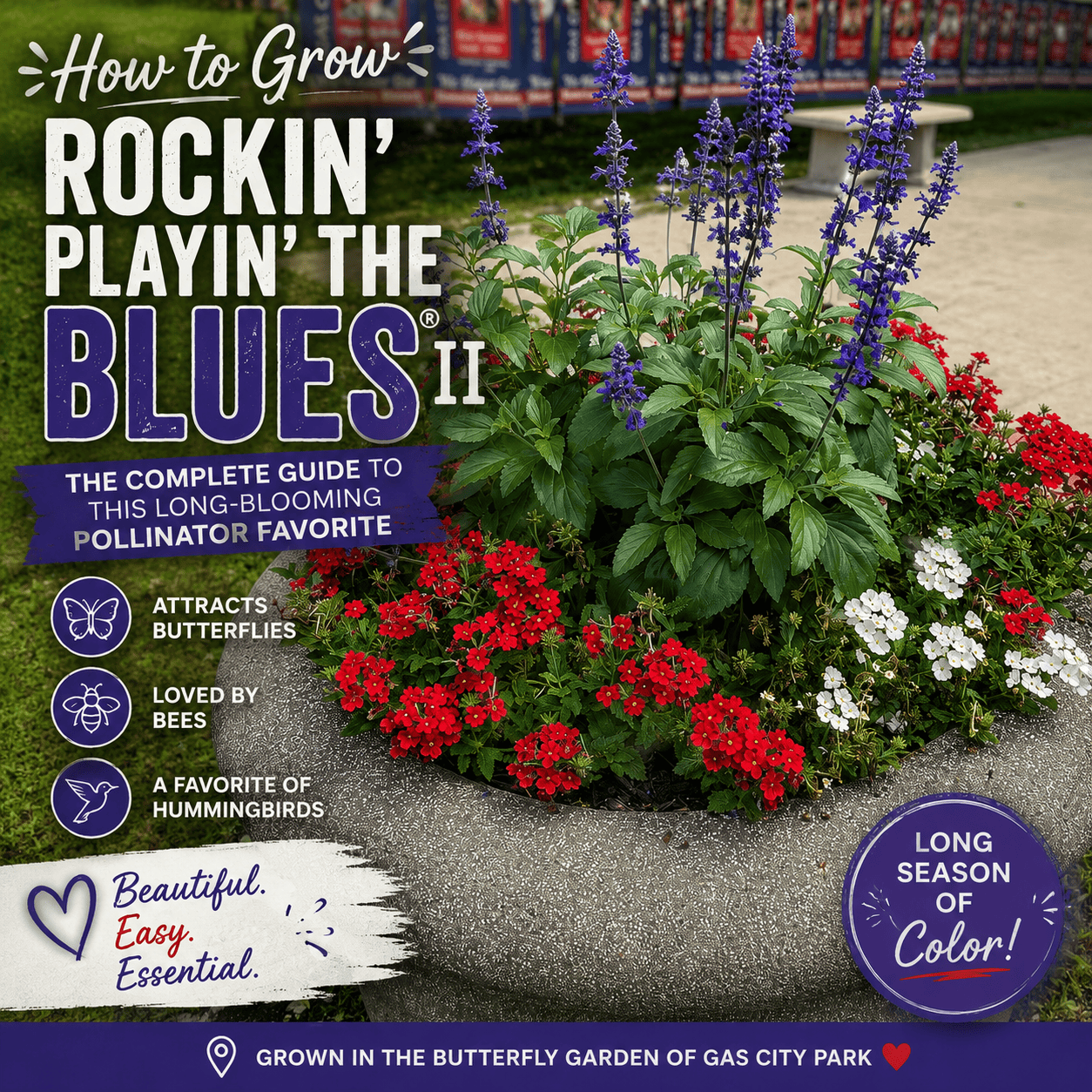
Visit the Butterfly Garden of Gas City
If you're near Gas City, Indiana, you don't have to take my word for how Rockin' Playin' the Blues® II Salvia looks in a garden. You can see it growing in the Butterfly Garden of Gas City.
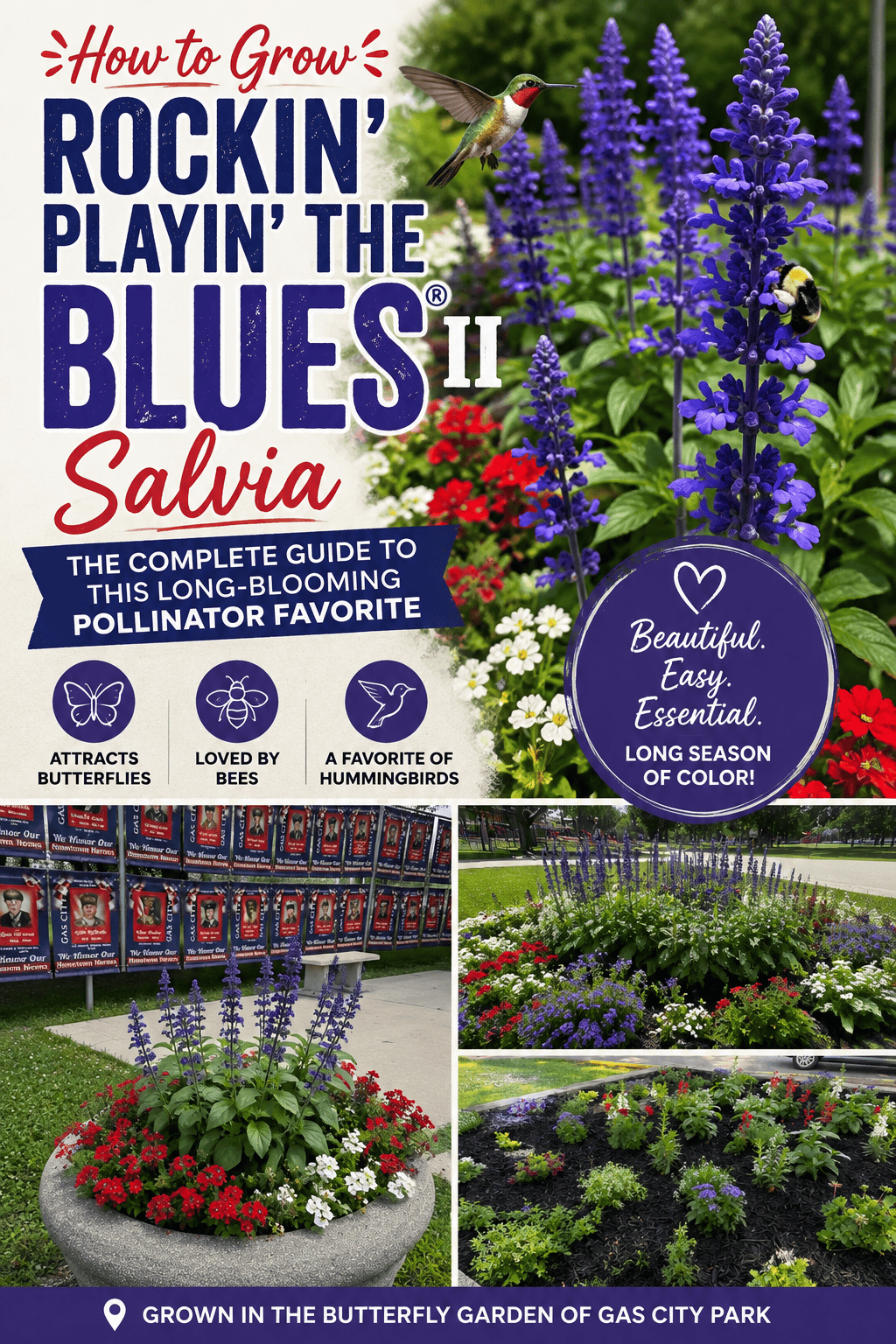
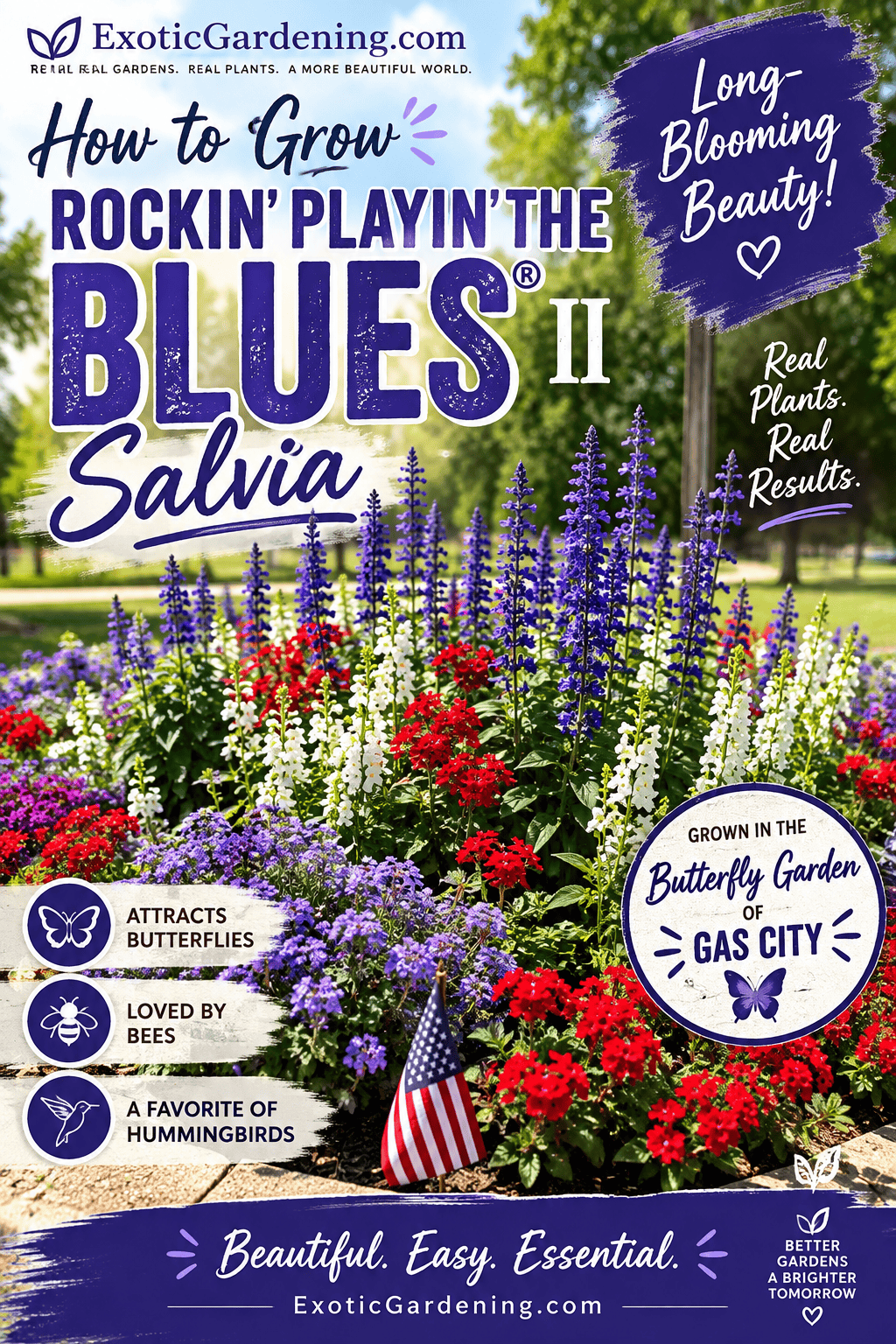
This year's red, white, and blue planting has turned into quite a display. The tall blue salvia rises above masses of red, white, blue, and purple flowers, creating the height I wanted in the bed while the lower-growing plants fill in around it.
And don't just look at the flowers.
Spend a few minutes watching what's happening around them. This is a butterfly garden, after all, and half the fun is noticing the visitors you miss when you walk by too quickly.
You may see bees working their way along the salvia spikes, butterflies moving through the garden, or, if you're lucky, a hummingbird stopping by.
I think that's one of the best parts of a public garden. You can see a photograph of a plant and decide it's pretty, but seeing a mature plant growing as part of an actual landscape gives you a much better idea of what it could do in your own garden.
If you visit, I'd love to know what catches your eye first.
Final Thoughts on Rockin' Playin' the Blues® II Salvia
So, after growing Rockin' Playin' the Blues® II Salvia for a season, would I plant it again?
YES!!!!!
And that answer probably tells you more than another list of its attributes would.
I've grown perennial blue salvias before, so I thought I had a pretty good idea of what to expect when I planted this one. I was wrong.
This is a completely different garden plant, and I like it better.
What won me over wasn't one particular characteristic.
It was the whole package.
I love the height.
I love how full the plants become.
I love those clusters of blue flowers standing above everything around them.
And I especially love seeing all the activity around them when the pollinators discover the flowers.
Most of all, this plant has been easy.
There are plenty of beautiful plants I enjoy growing even though I know they're going to make me work for the show they put on.
That's gardening.
But finding one that gives me this much impact without constantly asking me to do something to it?
I'll take that any day.
Rockin' Playin' the Blues® II Salvia isn't just a plant I'd recommend after growing it this year.
It's one I'll be looking for again next spring.


Leave a Reply